Lost In Translation: NASA, Warren Buffett, and Why Readability Matters

Simple strategies to ramp up your content’s readability
Lauren K. Howard, Principal Word Nerd, Indy Word Nerd Writing and Marketing
Imagine spending more than $327 million on a high-tech gadget only to have it burst into flames because you mixed up a few numbers. That’s exactly what happened with NASA’s Mars Climate Orbiter in 1999. The pricey spacecraft designed to study the Martian atmosphere is now better known as an interplanetary tale on the importance of readability.

When the team conducted a root cause analysis of the crash-and-burn failure, a surprising culprit emerged. The NASA and Lockheed Martin teams failed to convert English measurements to the metric system. Why? Back-and-forth emails and dense, jargony technical documentation buried the details. Guess you could say poor readability left some of the world’s smartest engineers “spaced out.”
As public relations professionals, we’re taught to be good writers. However, as attention spans get shorter and Google algorithms more complex, readability is increasingly important. Otherwise, you might find your audience as lost as the Mars Orbiter.
Avoid your own “Houston, we have a problem” moment with these readability tips and tricks.
What Is Readability?
People consume about 34 gigabytes of information daily according to research from the University of California, San Diego. That is equivalent to 100,000 words or 226 messages. How much of that information sticks with people relies on readability.
Highly readable content communicates ideas as clearly and accessibly as possible. When PR pros focus on readability, they increase the chance their target audience will consume and interact with the content. That is why the Center for Plain Language says that readability must be a strategic priority in content management.
Just the Facts, Ma’am
Ever been guilty of turning paragraphs into data dumps? Your audience hates that because human brains weren’t built to handle lots of numbers. Limit paragraphs to a maximum of three numbers. Whenever possible, present data visually through graphs and tables, even
in press releases. Mainstream news editors don’t understand your complicated numbers—and certainly won’t waste time trying.
Tell data through a story. In the book Actual Minds, Possible Worlds, psychologist Jerome Bruner writes that people are 22 times more likely to remember facts when they are part of a story. Did you remember the Mars Climate Orbiter before? Probably not. Will you remember this $300 million galactic readability gaffe now? Where there is data, a narrative always exists.
Skim, Scroll and Skedaddle
For the average web page, users allot time to read about 28% of the words. A better rule of thumb is 20% according to the Nielsen Norman Group. That means you need to pack a big punch in a little space.
- Prioritize the headline, deck, subheadings, bulleted lists and picture captions. These are what people scan first.
- Create a headline that conveys 80% of the message in about eight words or less.
- Write the page based on the user’s intent for visiting. Include the most important information at the top and don’t bury the call to action.
- Check Web Content Accessibility Guidelines conformance. An estimated one in every five people has a physical, visual, auditory, cognitive, or neurological disability that impacts web access. Yet a study of the world’s top 1 million pages shows 96% are not fully accessible.
Did You Get My Email?
Hamlet says, “To be or not to be.” The existential question for PR pros: “How can I get more people to read this email?”
Readability starts with the subject line. You need to catch the reader’s attention while staying true to the email’s content. According to Porch Group Media, 47% of email recipients open an email based solely on the subject line. But beware, 69% report emails as spam based on the subject line also. Mailchimp suggests subject lines of no more than nine words or 60 characters.
Shorter is better. Wylie Communications reports that 95% of an organization’s employees said they save an email for later if it is more than three sentences. That means you have about 150 words—or nine seconds—to grab the reader’s attention and convey the message.
A Little Light Reading
You’ll often hear people say they aren’t good at math, science, or sports. But you’ll rarely hear anyone admit they aren’t good at reading. Yet that is the case for most Americans.
The average reading level for U.S. adults is around the eighth grade. However, most of us prefer to read at least two grade levels below. Several research studies show that news stories written at the eighth-grade level and below get more site clicks and social media shares. If you’re looking for reach, write for a middle-school audience.
Less Is More…Much More
Most readers don’t invest in seemingly complicated content. Long paragraphs look time consuming. The New York Times averages 36 words per paragraph regardless of how complicated the topic is. Shoot for one idea in two or three sentences that takes up a max of five lines of page real estate.
LOSE THE LONG PARAGRAPHS:
1 IDEA | 2-3 SENTENCES | ≤5 PAGE LINESA strong correlation exists between sentence length and understanding. A research study of 410 newspapers by the American Press Institute found that:
- At eight words or less, readers understand 100% of the story
- Jumping to 14 words decreases comprehension to 90%
- Every additional word beyond 14 reduces understanding by more than 3%.
Shorter sentences. Smaller paragraphs. Simpler ideas. This is the winning readability combination.
Time Out
People are busy, so focus on reading time. The Pew Research Center reports that people will give an article about 2.5 minutes. You’ve got to have them hooked by then. Calculate reading time by dividing the total number of words by 200. Identify the two-minute mark and frontload key information before that point. Ensure the entire article is skimmable with interesting headings, bullet points and visuals.
Say That Again, but Slower
Seinfeld fans recognize this famous George Costanza phrase. It also applies to readability. Ditch the unnecessary adverbs that take up space. Use active voice to reduce word count and improve copy engagement. Most importantly, leave out the jargon whenever possible.
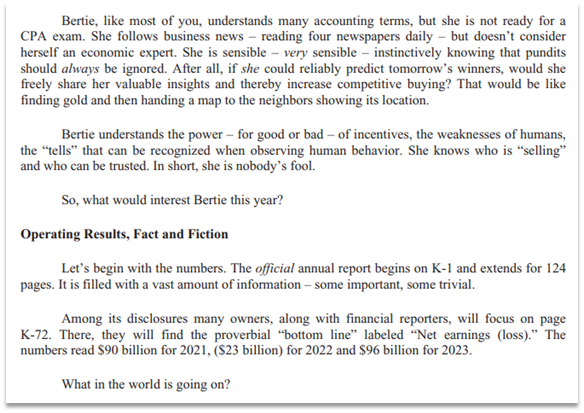
Warren Buffett—Oracle of Omaha, billionaire investor, creator of the world’s largest holding company—doesn’t write his annual shareholder letter as if any of this is true. In fact, for years he started with “Dear Doris and Bertie,” his two sisters.
His siblings operate outside the everyday business world. So, he constructs the letter as if they had been gone for a year and he’s reporting to them on their investment. Once the letter is complete, he removes the salutation and addresses it to all shareholders, not changing any of the content. This is a masterclass in how to prevent what’s complicated from impacting comprehension.
Where Readability Meets the Road
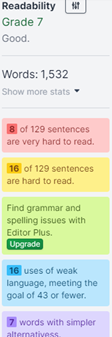
Writing for readability is tough. (Your author is stressed about how the advice doesn’t always match her writing in this article!) Luckily, there are tools at your fingertips to help.
- Hemingway Editor – Write your content and paste it into the editor. The tool offers several stats including grade level, complexity and passive tense. The editor even highlights sentences so you know exactly where to adjust the copy and why (for free).
- Flesch Reading Ease – Hitting a score of 60-70 indicates 83% of the population will understand the writing. Achieving this score means: 1) the piece speaks to middle-school reading levels, 2) averages 17 or fewer words per sentence, and 3) is around 1.47 syllables per word. You can access the Flesch Reading Ease score through the Microsoft Word editor.
Readability is one of a your most powerful tools to share a message, increase engagement and prompt action. From outer space to billion-dollar boardrooms, accessible communication is key to PR success. As you navigate the content universe, write for your own Doris and Bertie. It might create an out-of-this-world hit of planetary proportions.